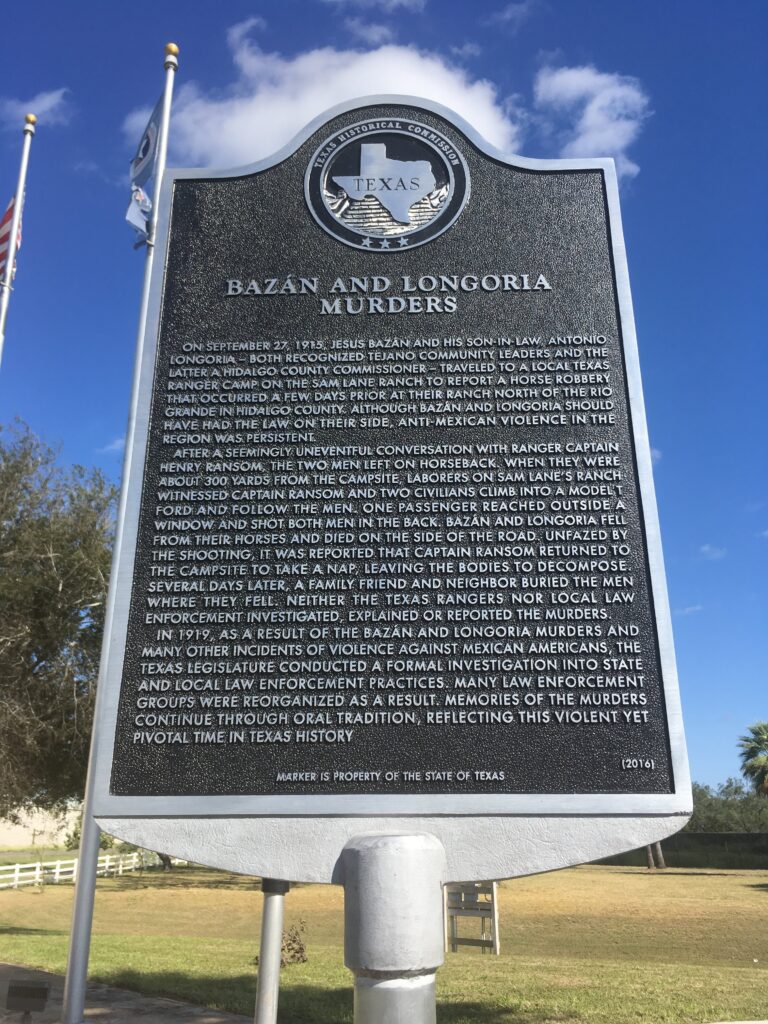
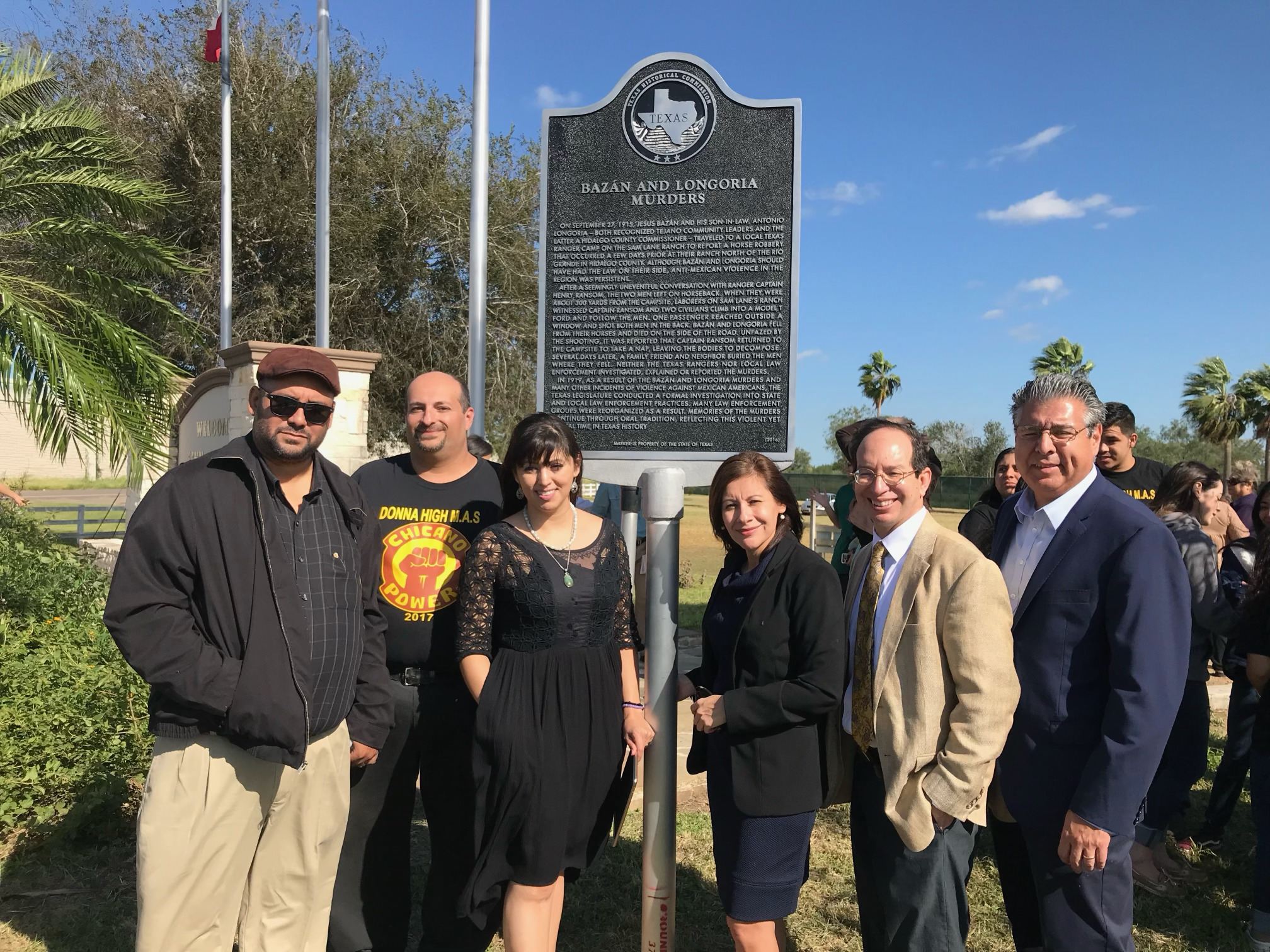
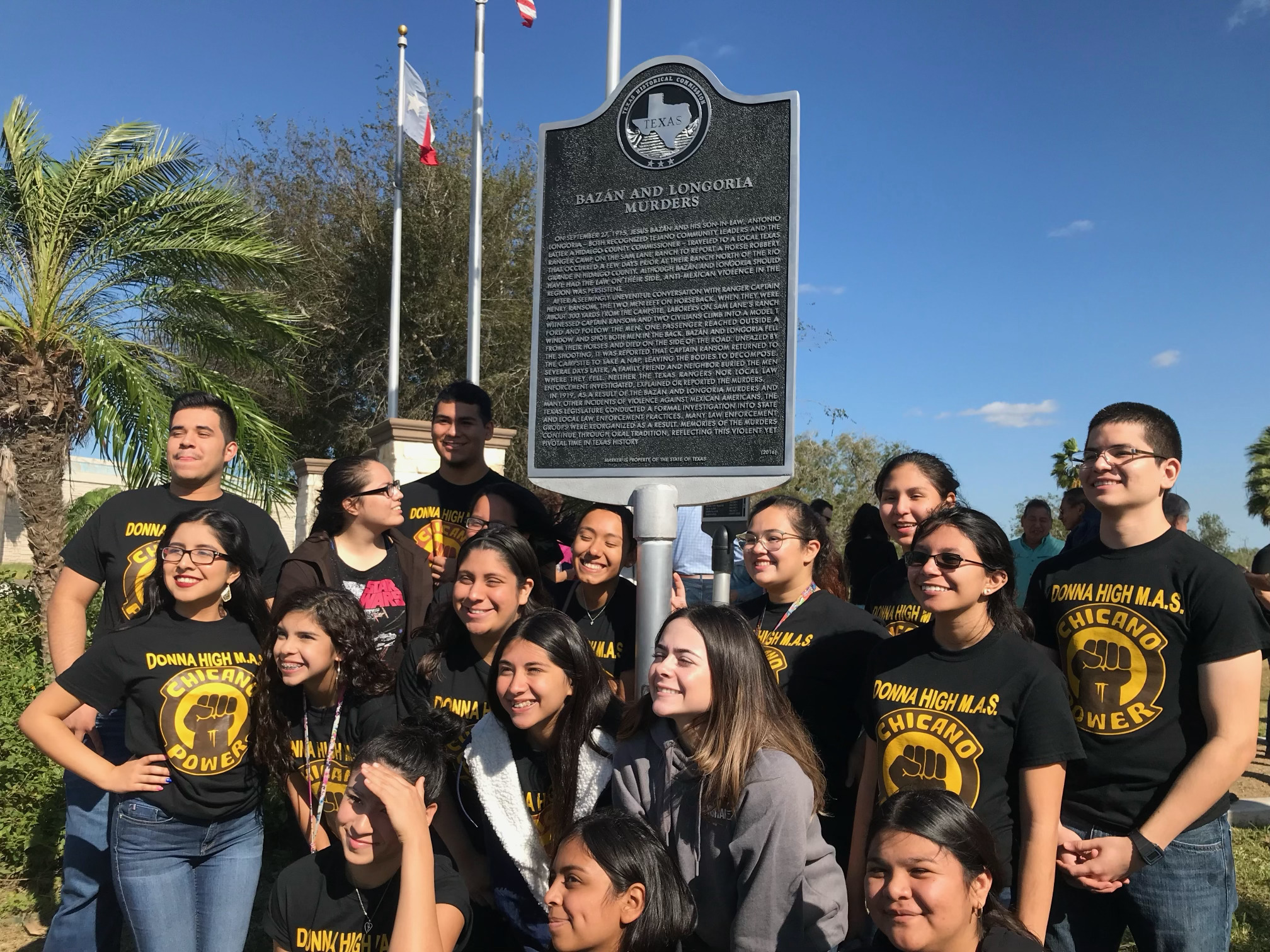
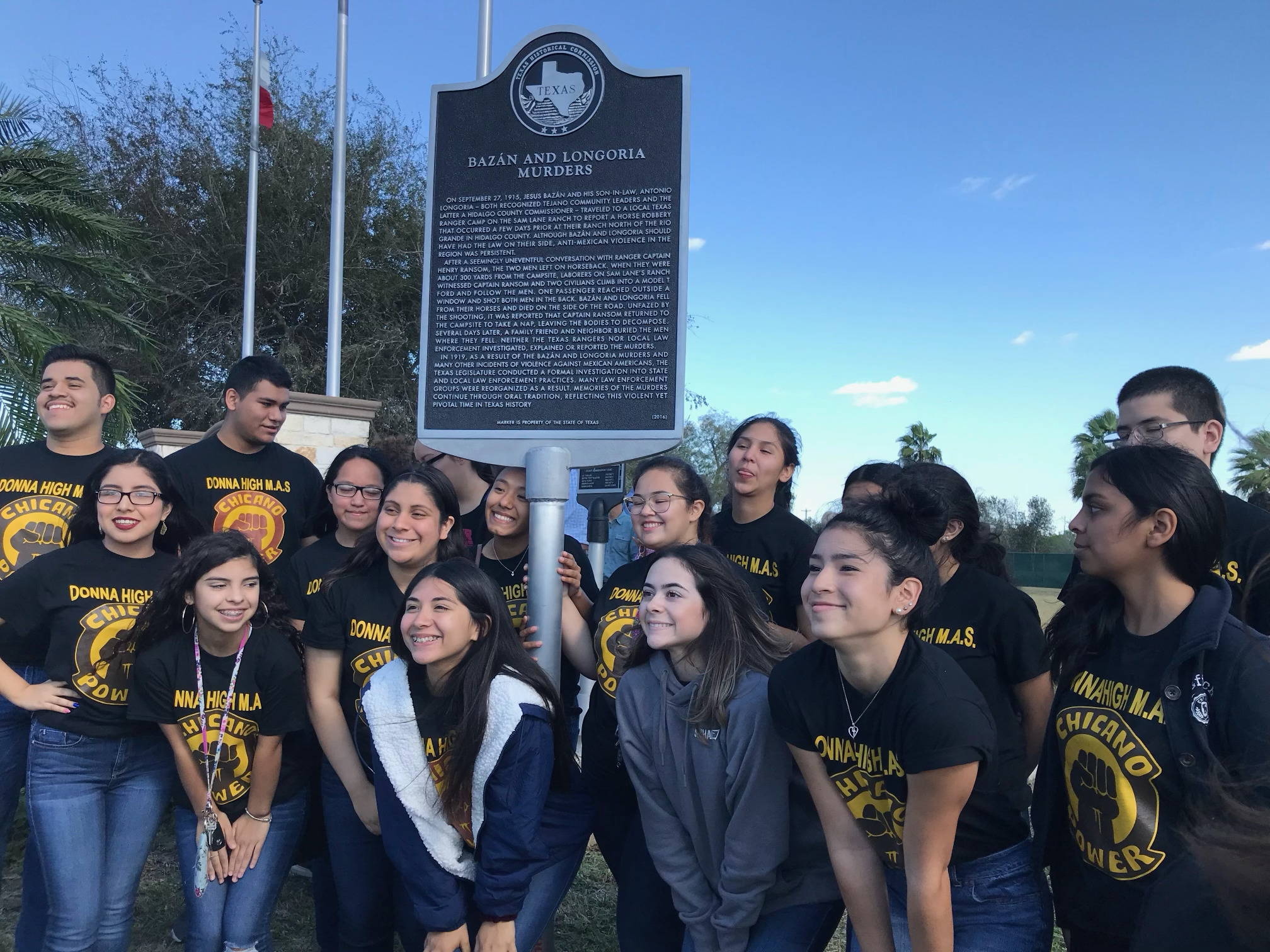
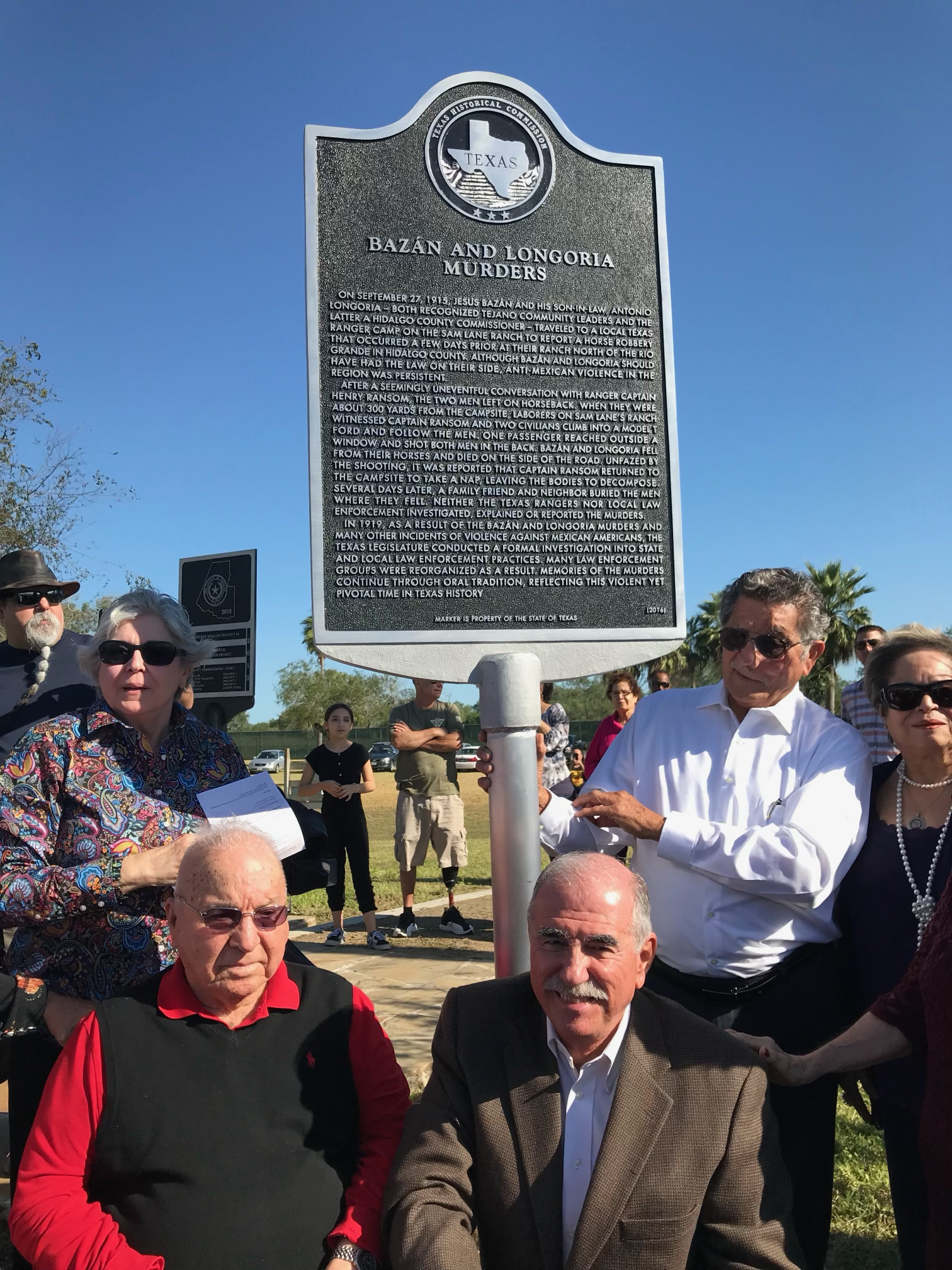
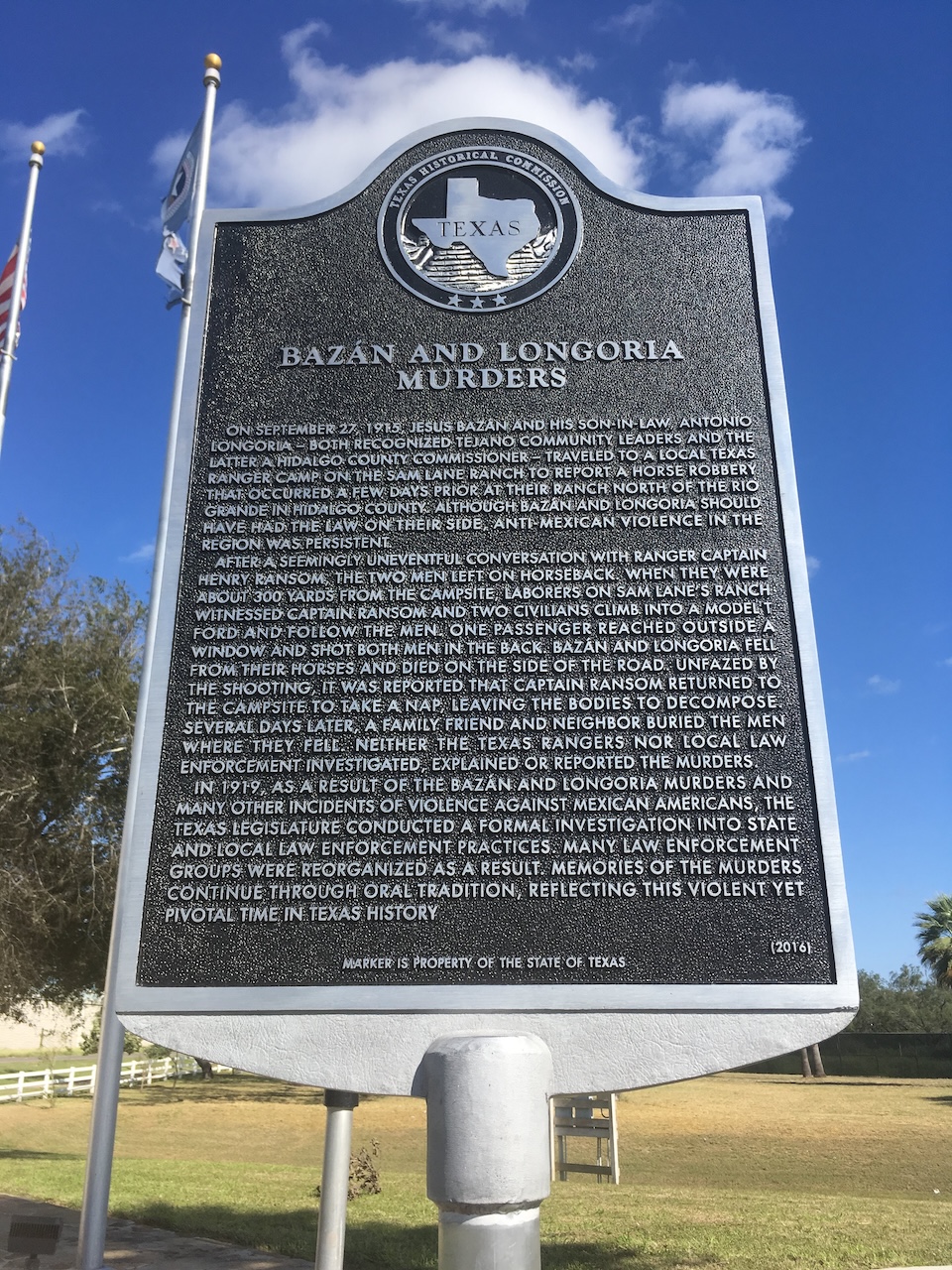
With the bright sun shining on his face, Ricardo Martínez addressed a crowd of around 130 people who gathered on November 3, 2018 at a historic marker unveiling near San Manuel, Texas. Martínez is the grandson of Antonio Longoria and great grandson of Jesús Bazán.
More than 100 years ago, on September 24, 1915, two prominent Tejanos, Jesús Bazán and his son-in-law Antonio Longoria, were killed by Texas Rangers near their family ranch in deep south Texas. Bazán and Longoria were respected members of the community; as they rode past the site of a raid, Ranger Captain Henry Ransom—with a long anti-Mexican résumé, fired at the men and proceeded to leave the site leaving the bodies behind. Local ranchers including former Ranger Sam Lane and worker Roland Warnock were shocked. Warnock, who later shared the history of the double murder with his grandson Kirby Warnock (the interview is the basis of the documentary Border Bandits), later participated in the burial of the bodies. The years leading up to American involvement in the Great War were particularly harsh for people of Mexican origin. The year 1915, was especially brutal. As the Mexican Revolution of 1910 raged on and news of uprisings quickly spread throughout the borderlands, U.S. authorities expeditiously labeled anyone of Mexican origin as a likely “bandit” justifying the killing or lynching of certain individuals. Such widespread disregard for ethnic Mexicans along the border and in the greater U.S. Southwest stemmed from nativist and racist claims that Mexicans, despite holding US citizenship, were culturally inferior. Such claims led to discriminatory laws, unequal education, labor segmentation, and most relevant to the Bazán and Longoria double murders, the basis for which the state allowed, encouraged, or directly participated in the killing of innocent people. Despite such reality, most Mexican American families when losing a loved one at least had some kind of documented proof of their loved ones’ death and more importantly, mourned them during a proper wake and burial. The Bazán and Longoria families had neither. No death certificate was ever filed for either of the men despite their respected places in south Texas society (Longoria was County Commissioner of Hidalgo) and the families were unable to hold a proper wake and burial.
Finally, 103 years later, the state of Texas acknowledged the indiscriminate way in which members of its elite force killed two innocent men. The descendants of Jesús Bazán and Antonio Longoria, many of whom were among the large crowd gathered in San Manuel on that Saturday morning, witnessed how community members and scholars as well as members of the Hidalgo County Historical Commission paid respect to their lost loved ones. While a historical marker cannot possibly heal wounds, it opens up much-needed conversations about the darkness in our state’s and nation’s history and how we can use such dialogue to create a more just world. The marker is testament to the resilience of the Bazán and Longoria families as each year passed by and as each generation of family members learned of the tragedy but could not fully understand it. Later that day after the marker unveiling at a panel comprised of descendants, Martínez once again spoke. He alluded to the word resilience which formed part of the panel title and reminisced about a conversation he and an acquaintance had some time ago. In a loud and clear voice Martínez told the crowd assembled before him, “that’s what my family did after all that happened…it was resilient, they showed resilencia.”