
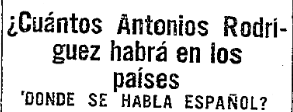
On November 17, 1910, El Tiempo, a Mexico City newspaper, wrote with an ironic, critical tone, “How many Antonios Rodríguez must there be in Spanish-speaking countries?”1 The note alluded to the various origins being attributed to Antonio Rodríguez, the Mexican lynched by a mob on November 3, 1910 (115 years ago) in Rocksprings, Texas. After Rodriguez’s arrest for supposedly killing Heffie Anderson, a white woman, a mob took from him his cell and burned him alive. According to historians William Carrigan and Clive Webb, the onlookers may have numbered in the thousands, a scale that gave the event the proportions of a spectacle lynching strikingly similar to those suffered by African Americans.2
Although virtually absent from public memory in Mexico, this case is central to the historiography of mob violence against Mexicans in the United States, particularly within Texas. Evidence of this can be found in the work of Mónica Muñoz Martínez, The Injustice Never Leaves You (2018), and Nicholas Villanueva Jr., The Lynching of Mexicans in the Texas Borderlands (2017). Both studies indicate that this is likely the most thoroughly documented lynching of a person of Mexican origin, notably because the episode sparked a broad reaction in Mexico. As Muñoz Martínez notes, “Finally, the lynching itself has endured as the most well-documented incident of anti-Mexican mob violence in the twentieth century. Newspapers, foreign and domestic, consulate records, and state records preserve the details of this act of vigilante brutality.”3
Diplomats serving under the Porfirian regime pressed the U.S. State Department to prosecute the lynchers. One day after the killing, Mexico’s ambassador to the United States, Francisco León de la Barra, telegraphed Enrique Creel, the foreign minister in Mexico, to inform him that a crowd had burned Antonio Rodríguez.4 Meanwhile, widespread press coverage of the lynching sparked protests in several Mexican cities, blending anti-American sentiment with growing exasperation toward the Porfirio Díaz regime. By carrying the story well beyond the borderlands to places like Guadalajara, Mexico City, and Chiapas, the press played a major role in driving these demonstrations. The graphic detail of the reports, combined with the indignation expressed by the editors, served to galvanize the Mexican public.5
For some American observers, the protests served to reinforce deep-seated racial prejudices rather than highlight the injustice of the lynching. This reaction is illustrated in a letter sent to President William Taft by F.W. Meyer, a Texas resident, explicitly complaining about the disturbances in Mexico City and Guadalajara. In his correspondence, Meyer dismissed Rodríguez as a “low-lifed Mexican Criminal” and argued that the protests in Mexico justified a radical retribution: the seizure of “one million of acres off of Mexico” for every American life lost.6 Meyer went so far as to assert that “the Mexicans murder good Americans because said greaser got his just dues from the People of Texas”.7 Thus, anti-Mexican prejudice and a desire for territorial retribution were clearly manifest in this instance.
The U.S. press quickly shifted its focus. Rather than dwelling on the lynching itself, English language newspapers emphasized the hostility displayed by the demonstrators. Thus, for example, The New York Times wrote of insults to the American flag, attacks on U.S. citizens in the streets, and the stoning of the Mexican Herald’s offices, elevating the incident to international proportions:
Through insults to the American flag and assaults made openly on American citizens in the streets, a demonstration against Americans, beginning last night with the stoning of the offices of The Mexican Herald, to-day developed into an affair of international importance.8
Despite that framing, other figures, such as Francisco I. Madero, then just days away from taking up arms, saw in those protests a prelude to what would follow once his revolution began. On November 12, while in Texas preparing to return to Mexico, Madero gave an interview to The San Antonio Daily Express about the demonstrations that were happening in Mexico: “These riots simply show the feeling of political unrest in Mexico (…) The masses are willing to take any pretext for such demonstrations,” he said, keenly aware of the implications for himself and his movement if he were to amplify the anti-American feeling while on U.S. soil.9
As noted, the lynching of Antonio Rodríguez triggered several narratives, each serving the interests of those who promoted it. Analyzing the lynching of Josefa/Juanita in Downieville, California, in 1851, Nicole Guidotti-Hernández shows in her book Unspeakable Violence: Remapping U.S. and Mexican National Imaginaries (2011) how the language surrounding acts of violence (in this case mob violence) can construct the subjects who become victims.10 In the case of Josefa/Juanita, complex even at the level of her name, Guidotti-Hernández underscores the lack of information before the lynching: “(…) it is as if she did not exist as a subject prior to that day.”11
Of course, Josefa/Juanita and Antonio Rodríguez have their own particularities and contexts; however, I argue that, similarly, Rodríguez was “constructed” in the days following his lynching. One of Ambassador De la Barra’s first orders to the consul in Eagle Pass, closer in proximity to Rocksprings, was to ascertain Rodríguez’s identity: “Please go, or send the vice-consul, to Rocksprings to gather information about Rodríguez’s execution and verify whether he was Mexican and had not lost his nationality under our laws.”12 De la Barra likely referred to the 1886 Law of Alienship and Naturalization, under which Rodríguez ceased to be considered Mexican in the following instances: (i) if he became a U.S. citizen; (ii) if he held a position in the U.S. government; or (iii) if he remained outside Mexico for more than ten years without a license or valid cause and without requesting an extension.13 Thus, the first thing the Mexican government needed to know was whether Rodríguez was, in fact, a Mexican national.
The case’s wide circulation in newspapers and official communiqués generated multiple descriptions of Rodríguez and a drive to answer the question “who was he?” Conflicting accounts spread about his origins and the whereabouts of his family: some reports claimed he had relatives in Mexico, while others said he was born in the United States. According to one version attributed to U.S. authorities—amplified by certain newspapers—he was from New Mexico; yet part of the Texan and Mexican press placed him in Guadalajara, Ciudad Porfirio Díaz, or Las Vacas.14 “Family members” also began to appear in various cities: a wife, mother, and daughter in Guadalajara; another mother in Eagle Pass; and a father in Coahuila.15
The consul’s investigation produced little that could establish Rodríguez’s identity with certainty, but it did reveal how identities are constructed in the wake of violence. The reconstruction ranged from physical descriptions to his portrayal as a stranger to Rocksprings’ Mexican community. The Eagle Pass News-Guide reported that the consul heard Rodríguez described as “Indian or part Black, since he was very dark.”16 After investigating in town, on top of saying “there was not the slightest unrest” between Anglo Americans and Mexicans in Rocksprings, the consul reported that and that Rodríguez was insane and a fugitive. After interviewing Mexican laborers, he noted they told him Rodríguez was from Las Vacas, today Ciudad Acuña, Coahuila.17 Conflicting accounts also circulated about why he was in Texas. Some newspapers described him as a migrant worker. Others exploited tensions in Mexico to present him as part of the movement against Porfirio Díaz. With the Plan of San Luis in circulation and anarchist groups active in the background, a rumor spread that he had fought in the 1908 battle of Las Vacas, battled between anarchists and federal troops, and was traveling around Texas ranches recruiting sympathizers.18
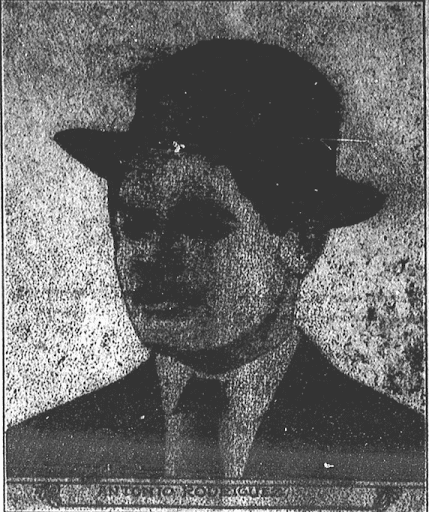
On November 24, 1910, El Regidor of San Antonio even published a purported photograph of Rodríguez, wearing a hat and suit. But with no way to confirm it was him, the image must be taken as another source that complicates who he was and what he looked like.
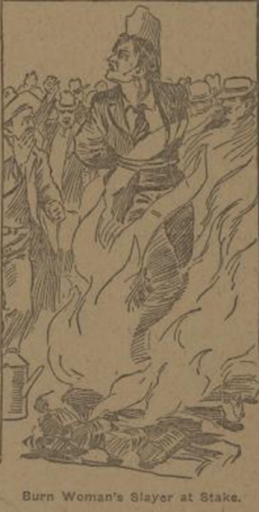
Antonio Rodríguez was defined by his racial profile and the crime he allegedly committed. For instance, the Bryan Daily Eagle described him as “The Mexican who had murdered a white woman (…).”19 A month after the lynching, the New Ulm published an illustration of Rodríguez at the stake with the caption: “They burn at the stake the murderer of a woman.”20 At the center we see a man tied to a post, wearing a coat and tie. He looks to the side with a tense expression while flames engulf him from the feet to the waist. Around him stands a crowd of onlookers, all men. The narratives justified the lynching, or at least failed to condemn it forcefully.
Contemporaries did not overlook these multiple identities. The El Tiempo article that opened this piece, the newspaper was well aware of how hard it was to pin down his identity, and confined itself to saying: “We ourselves have known many Mexican men named Antonio Rodríguez, some of whom have disappeared from our view; but from this we do not infer that any of them was the man lynched in Rock Springs, nor are we in a position to assert that none of them was the lynchers’ victim.”21 The paper’s words struck a skeptical tone toward what it saw as a fruitless crusade.
Rodríguez’s identity did not preexist the lynching; on the contrary, the event unleashed the invention of identities. If Rodríguez had been born in the United States, Mexico had no grounds to lodge a claim. In fact, Muñoz Martínez notes a rhetorical shift in the press: from viewing him as an external threat to recasting him as an internal problem.22 If Rodríguez was a revolutionary, lynching him seemed, to some, a way to neutralize a potential insurgent in the United States. If he mattered only as a criminal, the lynching became, in those eyes, justifiable.
In Mexico, more than a few saw in Rodríguez the situation of people of Mexican origin in Texas. The editors of El Debate wrote that, to Americans, especially Anglos, Mexicans were seen as inferior just like African Americans. The proof was the lynching: “The shod hoof of the Texan Yankee no longer pours out its barbarous, savage racial hatred only upon the Black man; its rottenness has burst forth, wounding and killing in an iniquitous lynching a Mexican.”23 In both Mexican and U.S. narratives, he was referenced simply as “the Mexican.” In any case, the competing versions of Rodríguez show how mob violence reshaped the identity of the lynched man to suit Mexican and U.S. interests alike.
The lynching of Antonio Rodríguez is the best-documented case of a person of Mexican origin killed by mob violence. For that very reason, it offers several avenues for analysis, and I find it useful to consider it through the lens of how an individual is constructed in various aspects after being lynched. Something I have noticed in researching my master’s thesis is that the case’s extensive documentation reveals a key aspect for thinking about violence and its victims: how the former ends up constructing the latter. His case shows how violence, through language, constructs individuals. Such violence persists; we can see it today, and along with it, different rhetorics circulate that, for various reasons, end up defining those who have been harmed. It is always an incomplete construction, of course, for, in this case, we may never know in detail who Antonio Rodríguez was.
– Ignacio E. Anaya Minjarez, Universidad Iberoamericana, Mexico City.
- “¿Cuántos Antonios Rodríguez habrá en los países donde se habla español?” [“How Many Antonios Rodríguez Must There Be in Spanish-Speaking Countries?”], El Tiempo (Mexico City), November 17, 1910. ↩︎
- William D. Carrigan and Clive Webb, Forgotten Dead: Mob Violence against Mexicans in the United States, 1848–1928 (Oxford: Oxford University Press, 2017), 81. ↩︎
- Mónica Muñoz Martínez, The Injustice Never Leaves You: Anti-Mexican Violence in Texas (Cambridge, MA: Harvard University Press, 2018), 31. ↩︎
- Francisco León de la Barra, telegram to the Secretary of Foreign Affairs, Washington, D.C., November 4, 1910; Embajada de México en los Estados Unidos records, caja 343, exp. 7, f. 2; Archivo Histórico Genaro Estrada, Secretaría de Relaciones Exteriores (AHGE-SRE), Mexico City.
↩︎ - Nicholas Villanueva Jr., The Lynching of Mexicans in the Texas Borderlands (New Mexico: University of New Mexico Press, 2017), 56. ↩︎
- F. W. Meyer to William Taft, President of the United States,” Nov. 10, 1910, in F. Arturo Rosales (ed.), Testimonio: A Documentary History of the Mexican-American Struggle for Civil Rights (Houston: Arte Público Press, 2000), 123. ↩︎
- Ibid. ↩︎
- “Rioting in Mexico against americans”, The New York Times, November 10, 1910. ↩︎
- “He Says It Is Anti-Díaz,” The San Antonio Daily Express, November 12, 1910. ↩︎
- Nicole M. Guidotti-Hernández, Unspeakable Violence: Remapping U.S. and Mexican National Imaginaries (Durham, NC: Duke University Press, 2011), 38–40. ↩︎
- Ibid., 41. ↩︎
- Francisco León de la Barra, telegram to the Mexican Consul in Eagle Pass, Texas, Washington, D.C., November 9, 1910; Embajada de México en los Estados Unidos records, caja 343, exp. 7, f. 18; AHGE-SRE, Mexico City. ↩︎
- México, Congreso de la Unión, “Ley sobre Extranjería y Naturalización (Decreto de 28 de mayo de 1886)” [“Law on Alienship and Naturalization (Decree of May 28, 1886)”], in Código de Colonización y Terrenos Baldíos, art. 2, incs. III, V y VI [secs. III, V, and VI]. ↩︎
- Nicholas Villanueva Jr., The Lynching of Mexicans in the Texas Borderlands, 57; “¿Cuántos Antonios Rodríguez habrá en los países donde se habla español?” [“How Many Antonios Rodríguez Must There Be in Spanish-Speaking Countries?”], El Tiempo, November 17, 1910; El Demócrata Fronterizo, November 19, 1910. ↩︎
- Mónica Muñoz Martínez, The Injustice Never Leaves You, 43; “Antonio Rodríguez,” El Regidor (San Antonio), November 24, 1910. ↩︎
- “Consul Villasana Returns,” Eagle Pass News-Guide, November 19, 1910. ↩︎
- Ibid.; “Qué se dice y qué se piensa en los Estados Unidos acerca de la intentona de la revolución en México” [“What Is Said and Thought in the United States about the Attempted Revolution in Mexico”], El Tiempo, November 21, 1910. ↩︎
- “Texas Town That Burned Mexican Is Not Worried,” San Antonio Light and Gazette, November 14, 1910. ↩︎
- The Brian Daily Eagle and Pilot, November 10, 1910. ↩︎
- “Woman’s Slayer Is Burned by Texas,” The New Ulm Enterprise, December 16, 1910. ↩︎
- “¿Cuántos Antonios Rodríguez habrá en los países donde se habla español?” [“How Many Antonios Rodríguez Must There Be in Spanish-Speaking Countries?”], El Tiempo, November 17, 1910. ↩︎
- Mónica Muñoz Martínez, The injustice never leaves you, 43. ↩︎
- “La pezuña de dollaria” [“The Dollar Hoof”], El Debate, November 5, 1910. ↩︎